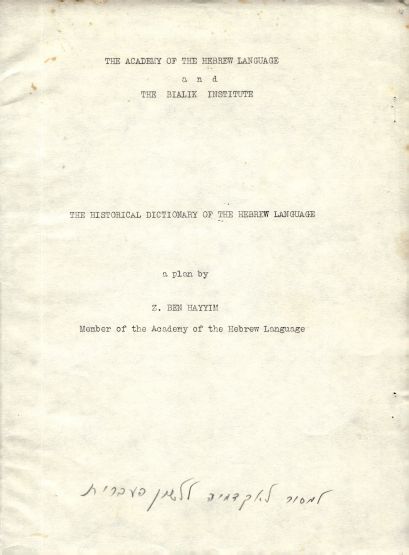
Fe THE ACADEMY OF THE HEBREW LANGUAGE
ra Seeeee 6 See Be
= THE BIALIK INSTITUTE —
THE HISTORICAL DICTIONARY OF THE HEBREW LANGUAGE
& plan by
Z. BEN HAYYIM
Member of the Academy of the Hebrew Language
A 190v0 pst a9 phd onl
The Academy of the Hebrew Language in Jerusalem has,
1)
since its foundation’, concentrated its activities mainly in
the realm of lexicography. It has compiled and published
handy dictionaries in various fields but in particular in the
various branches of the technical sciences. Such activity was
dictated by the needs of the developing Hebrew Language which
has once more become a spoken tongue by the Jewish people
living in Eretz Israel. Since 1936, the lexicographical acti-
vities of the Academy have been supported by the Bialik Institute
of the Jewish Agency.
Some years ago, the Academy of the Hebrew Language and
the Bialik Institute decided to launch the enterprise known
as "The Historical Dictionary of the Hebrew Language" in addition
to "The Dictionary of the Language of the Bible”, While the
preparation of the latter is being conducted under the guidance
of Professor N.H. Tur-Sinai, President of the Academy, the
writer of the following pages has been entrusted with the task
of directing the preparations for the “Historical Dictionary"
which is now in progress.
The following pages which were submitted on 2/1/1959 to
the Academy and approved as a basis for the preparatory work of
the Dictionary, are intended to draw attention to the problems
involved in the preparation of such a Dictionary and to the
methods that have been adopted. This proposal was drawn up
following a thorough investigation of the structure of similar
Ge
Dictionaries of the languages, especially of Indo-European
languages, and after examining the methods adopted by similar
lexicographical enterprises.
in the meaning of Jp,
from the point of view of the local and temporal origin of the
various books of the Bible.
True, there is a type of dictionary which serves as an end
in itself, that being linguistic, namely a presentation of the
vocabulary of a certain language whether from the geographical
(such as dictionaries of various dialects), the historical, or any
other point of view. If a dictionary of this type intends to present
a language of the past and is based entirely on written texts,
these texts serve only as a source. Obviously, such dictionaries
must not overlook obscure and doubtful passages and hapax legomena,
but deal with them briefly, in proportion to their importance in
‘
the overall picture of the language of those texts.
Hence it follows that a clear definition of the nature of
the proposed dictionary must Cmanede any practical work in its
preparation, not only as regards the work of editing but also as
regards the collecting of the material. Any person engaged in sueh
a dictionary must, when gathering material from the sources, and
certainly when sifting the material gathered for the purpose of
introducing it in the dictionary, have before his eyes the purpose
that the dictionary is to serve. The dictionary we have in mind -
Se ae ~
re Fe.
Ca Sb IY ss ¢
yey
ice
ee oe
and I take it we are all agreed on this matter-will be a
Dictionary of the Hebrew Language on historical principles, which
is not a means to an end but an end in itself, that being a
presentation of the stock of Hebrew words from the earliest begin-
nings down to a certain period.
Furthermore, even within the limits of the presentfaper,
we must clarify an additional point and decide upon it, in order
that the work of preparing the material for such a dictionary may
be done with a clear end in view.
Despite the numerous consultations of the Editorial Board,
it has not yet been definitely established whether the "Historical
Dictionary" shall be a combination of various "Period Dictionaries"
that are independent works in eraneclwes” 2. or whether it should
be one comprehensive dictionary embracing all the periods from the
inception of the language down to a certain time. On the face of
it, this is a purely teclical matter with little bearing on the
preparatory stage and the gathering of the material for the
Dictionary in one of the two forms mentioned. Indeed, I was of that
opinion for many years, but I now realize that this is not the
case. While engaging in the gathering of the material, we must
already have a clear knowledge as to which of these two forms of
dictionary we have in mind, for “Period Dictionaries" necessitate
& wider documentation and an exhausting of the linguistic material
from all the sources relating to the period, or at least one as
full as possible.On the other hand, one comprehensive dictionary,
l)cfr.: W.A. Craigie, New Dictionary Schemes Presented to the
Philological Society, April 4th 1929 (Transactions ete.1925 -
30 pp. 6ff.), as well as: The Value of the Period Dictionaries
Transactions etc. 1937 pp. 52-62).
45
while it must be based on a very wide range of material, must
renounce completeness,which is indeed not required for a present-
ation of the history of the stock of Hebrew words in their overall
development.
It would appear to me that we must decide on one comprehen-
sive historical dictionary to embrace all periods. Not only has the
lack of such a work been most deeply felt, but it may also serve as
an excellent basis for the preparation of special Period Dictiona-
ries at some later date. Lexicographical work in English has
developed along these lines. It is on this assumption, therefore,
that the following remarks have been written,
B. The Foundations and Scope of the Dictionary
a. In dictionaries running into numerous volumes, which are
published over a period of many years, one can always sense tangible
differences between the first volume (or volumes) and the last
volumes, differences which generally impair the uniformity of the
work as a whole. Insofar as such differences are the result of new
achievements in research, the revelation of new facts or new
concepts, not only can not be avoided, but they must not be avoided,
for each additional volume must necessarily be the last word .t the
time of its publication. However, one can prevent differences
impairing the uniformity of a work in the sphere of documentation.
It is to this that the authors of various and important dictionaries
have not paid sufficient attention betimes, For the sake of uniform-
ity of material, one must fix a date-line beyond which no fresh
ooDee
material is admitted to the dictionary, and anything cropping up
after such a date is left for the supplementary volumes or for a
new eaition of the dictionary. This must certainly be the guiding
principle for a dictionary which is a permanent enterprise, a work
which will always be in preparation, a dictionary for which no
sooner has the collection of material for a certain edition been
completed, than one begins collecting material for sup olementary
volumes or for a succeeding edition. I propose fixing the year
1947 as the last date for the collection of material for the basic
edition of the Historical Dictionary. The year 1948 marks a turning-
point in the history of the Hebrew language, for in that year it
returned to full political life, and one need not dilate on this
subject ies This date-line does not imply that the collection
of material from the year 1947 onwards must be relegated to some
later period. On the contrary, it is desirable - if a budget is
available - to engage in such work concurrently so that it be ready
and in the hands of the Editorial Board on the completion of the
basic edition of the dictionary,
b. I am of the opinion that we must regard the "Historical
Dictionary of the Hebrew Language" as a permanent enterprise and
not as a one time undertaking, although such work may take many
years to accomplish, It is from this viewpoint that we must compile -
the entry—cards according to such a system as makes it possible for
us to maintain this card-index up-to-date and ready for use. One
may compare it to a card-index catalogue of e library that grows
with the increasing stock of books in the library, and is always
up-to-date,
‘ ee
ce Having decided on the nature of the Dictionary, and having
decided to turn it into a permanent enterprise over generations to
come, we must first of all fix its basis and scope before embarking
on a collection of the material for the two purposes,
It would undoubtedly be ijeal to base the Dictionary on all
the written texts in Hebrew, beginning from the ancient documents
in the Bible,and on all the early epigraphic material down to
publications as far as the end of 1947. The use of all written
material during this period for the purpose of compiling the
Dictionary would necessitate the reading of books and the marking
of entries into cards by an appreciable number of people over
scores of years, and the writing up of the material and the editing
it in book form beconess so distant a goal that the enthusiasm even
of those who are not urging a speedy com letion of the work may be
damped. If we add to this the textual problems of very many sources,
the attainment of the goal would become still more distant. I be-
ieve that we must decide beforehand that the basic edition of our
Dictionary should be founded on only part of the texts, but such as
are fully representative of the whole gamut of Hebrew linguistic
creation. If, for example, there are about thirty thousand literary
units!) written in Hebrew, we must base the Dictionary on about
T) ; eee : ; :
The term, "literary unit" is used in order to avert the misunder-
standing that the word "book" vould give rise to. Is the Talmud as
a whole one “book™ or six “books” according to the six Orders of
the Mishna, or is each tractate of the Talmud a book in itself?
The same applies to any one poem of a writer, which has sometimes
been published separately and sometimes has been included in a
collection of poems by the same person. According to Friedenberg's
"Beth 'Eqed Sefarim" I have counted 28,500 units. But this catalogue
includes also works not written in Hebrew, but printed in Hebrew
characters, and does not include works that’ have not appeared in
print and are still preserved in manuscript. The dictionary mst
take cognisance also of works not yet published, which could easily
be obtained from the Institute for Microfilms of Hebrew Manuscripts,
attached to the Ministry of Education and Culture.
of
twelve thousand such units which shoud be chosen strictly according
to certain criteria to be laid down. The figures given above are
tentative only and net intended to fix any prineiples.
d. I take the liberty of mentioning several criteria for the
choice of the “literary units". Obviously the members of the
Editorial Board, each an expert in his own field, will have to give
special consideration to this problem, The basic material should
include:
: The important works in every generation, which have wielded
great influence on the nation and on the Hebrew language during
succeeding generations. This can be established to a certain extent
technically, for these will necessarily be works that have run
into numerous editions in the course of generations and the Diction-
ary cannot ignore them,
é
roa Works which are not important in themselves, from the
literary or any other point of view, but which fill a gap from the
historical point of view, that is from the point of view of the
history of the language. For we must aspire to it that each word
or expression shall have in the Dictionary at least one documenta-
tion within a span of 100 years if not less than that (whenever
possible, of course) in ancient times; and at least one documenta— ~*
tion in a span of 30 years from the Haskalah period (18th Century)
and onwards;
;= Works of the type mentioned in paragraph 2, which may
contribute to the knowledge of a local idiom. Such aspect, it
would appear, has so far merited little attention. I mean that one
Bree
Se
must include in the basic material works written in various count-
ries of the Jewish Diaspora, in order to illustrate the use of the
Hebrew language in these countries, in which the spoken language
of the Jews differed. In such instances, one must include works
which are not important in themselves, such as, for example, a
book of Responsa, which is not of intrinsic value and is not famous,
in order that one may include documentation drawn therefrom in the
Dictionary.
4. Works reflecting various stylistic standards in one genera—
tion, such as Juridical language (including the language of the
Halacha and laws and regulations issued by various communities)
the language of story and narrative, poetry, liturgical literature,
ete.
e. The choice of these "literary units" should be made at least
with the aid of the members of the Editorial Board who are experts
in various fields, if it is impossible for each of them to undertake
to present a list of the units in his own particular field,
r. A "List of Sources" should be prepared setting forth the
literary units that the Editorial Board agreed to include in the
"basic material". Such a list must include the following data:
iz Names of works and their authors in chronological order. For
practical reasons, I suggest that each author be given an ordinal
number, as is the case in the Thesaurus LinguaeLatinae,
as Abbreviations of names of works to be included in the entry-
‘ re
ecards.
br Mention of the edition or manuscript of any work that the
Dictionary generally bases itself on, and the edition or manuscript .
that must be compared for the purpose of establishing the correct
reading of the text.
4. A statement as to whether quotations from the work in
question will be taken by “mechanical registration" or by “regist-
ration by selection", (This is, of course, important if it should
pe decided to introduce the system employed by Thesaurus Linguae
Latinae).
The"List of Sources" which sets forth the foundations of the
Dictionary should be published in the form of a booklet and time
should be allowed for scholars in the various branches of Hebrew
literature to give their opinion of it and to suggest amendments.
On the elapse of the date-line, the Editorial Board shall consider —
all the questions raised by the list and arrive at a final decision.
Zo It is according to this list that the reading of the
“literary units" and the entries on the cards shall be made. It is
necessary, of course, that the reading of the works shall be
entrusted to many people, to an unlimited number of people in fact, ‘
whether they be paid readers or volunteers, The choice of readers x
should be governed by the data contained in the "List of Sources":
sources which have no reliable editions or the texts of which
require special preparation for the Dictionary, shall be read only
by specialists in the field. And it is they who shall mark the
. cakes
material requiring entry on the cards. The copy serving as a basis
for the material included in the Dictionary shall remain at the
disposal of the Editorial Board for study and reference whenever
need arises.
(It should be remembered that the preparation of the "List
of Sources" with us is not a task which can be regarded as mainly
technical, but is a scientific work in itself. I have in mind, in
particular, all the period down to the 10th Century and certain
tipes of literature beyond this period, for a considerable part
of the sources are anonymous and there are differences of opinion
in regard to the date of their creation and, in certain cases, also
in regard to their place of creation. For that reason the work of
preparation of such a "List of Sources" will take a considerable
time before we can make use of the works and enter them on to the
cards.)
sate Simultaneously with the preparation of the "List of Sources"
one should prepare also a “List of Lemmas", which I would call the
Seope of the Dictionary.
I take it that all the members of the Editorial Board will
agree that this comprehensive Dictionary has no room for merely
technical terma which were not in general use, or for mere neolo-
7
gism proposed by individuals which were not, or generally not, in
use in the language. The place of such words is in specialized
dictionaries. Of course, one must apply a different criterion for
the language in ancient times than for the language of the period
closer to our own. This is not the time to consider the criteria
sabes
to be applied for the inclusion or exclusion of words. I shall seek
an opportunity of making suggestions in this respect on Some more
fitting seeasion. One must, therefore, fix all the lemmas of the
Dietionary for which documentation will be sought after the "List
of Sources" has been prepared. It is clear of course that in the
preparation of the "List of Lemmas", numerous linguistic problems
will arise, such as that of the spelling and vocalization to be
adopted in the Dictionary for the lemmas; the fixing of the order of
words which are alike in spelling but different in vocalization
as for example, win win vIn oun ; which Aramaic words are to be
included in the Hebrew dictionary; etc. - problems that are likely
to occupy the meetings of the Academy and of the Committee on
Hebrew Grammar for a considerable time. Existing dicdionaries should
serve as a basis for the preparation of the list.
+ It would appear that only after the "List of Lemmas" is
prepared will it be possible to begin listing the bibliography
relating to the various items, for the listing of the bibliography
must conform to the lemmas. True, all forms of spelling of the
words will be given in the Dictionary, and each in its proper
alphabetic order, but all the quotations, including those of words
of different spelling, must be brought together under the lemma,
the spelling of which is normalized, For example, if it should be
decided that the spelling of the words ,ODN ,ny70D ,MUD ,OO10,
noap ,o7bon ,nII etc. is adopted for the lemmas, then all the
quotations, even such where the above-mentioned words appear under
the spelling 1n3p ,o0?0>0 ,n170 ,wDN ,ny?vy ,ndDY ,DMI” Will be
* aes .
given under the items avo ,vo1o etc. whereas the words nyv ,ov 17
etc. will be entered in their proper alphabetic order but will
have cross-references to the lemmas, This, of course, is essentia-
lly a technical rather than a linguistic matter, and for that
reason it will not give rise to great differences of ae But
here we touch upon a much more serious question, decidedly lingui-
stic in nature, because it is no longer one of spelling alone,
particularly not so in regard to the language of the present
generation and to the pronunciation which is regarded as ntathacds
The question boils dowm to this: let's take such words as
SPOVNASPONNN ,POPRITIUA ,MIDALATIN ,ARIVALARIIR , POAT, PII
SPRTIDORSPTIOL7R ,OpPOL0ID ,DOIPLOOID , TIL III , IFS TDIK ,TIRIEWS
,TI2DaAMOLFI7VAD. «=, OP TIPIDI0"71PID por 277250777719 ,OTHTS 01H
,MIRTLAIING AAR . Will each word in the above pairs be regarded
as a separate word and so @pear in the Dictionary as a distinct
entry and carry with it its own quotations, or should these pairs
be regarded as one word in its historical and local variations,
and hence be given under one entry together with all the relevant
quotations? We must answer this serious question before beginning
the preparation of the card-index. I think, however, that we can
begin a consideration of this question only after we have the
"List of Lemmas" for the latter will present us with all the
material requiring consideration and decision.
At first sight, I think it would be good if we established
the identity of each word in its historical process according to
its meaning. By so doing, we should be able to unite under one
wee e
ee ad
we oe
owe Das
entry, everything that is really identical from the point of view cf
meaning and content, but has changed in the course of time whether
in spelling or in pronounciation by various Jewish communities. F
Such a method will also help us to overcome the really difficult
problem in that a certain word, in a certain source and context,
appears in different forms in various manuscripts and editions, as
given above. However, I am not making any suggestions here as to a
solution of the problem. I am only raising points worthy of consi-
deration, for the matter requires serious and minute examination,
At any rate, the mentioning of this problem shows that the prepa-
ration of the "List of Lemmas" in advance is indispensable for a
systematic preparation of the Dictionary. Experience in other
undertakings has shown how necessary it is to prepare beforehand a
list of lemmas and that one must not rely on what will emerge while
the compilation of the dictionary is in process, All editors of
dictionaries with whom I have talked stressed the fact that wherever
they had not a properly prepared list of lemmas in front of then,
they found it most difficult, as time went on, to find their way
through the maze of cards of entries which had not been arranged
in accordance with a list of lemmas fixed inadvance, with the result
that numerous entries escaped the attention of the editor when
engaged on certain items,
I suggest including in the Dictionary an idex of words
arranged according to their formations and word patterns (mishqalim),
for this will be a weighty contribution to the historical morphology
of our language, One should perhaps pay attention to this question
o14,.
before beginning a preparation of the "List of Lemmas". Otherwise,
a clarification will be necessary of various basic problems in
Hebrew grammar before drawing up the Dictionary because no good
scientific dictionary is imaginable without a basically clear
grammatical "ideology".
The two branches of activity mentioned above: that of
laying the foundations for the dictionary ("List of Sources") and
fixing its scope ("List of Lemmas") must precede any other work on
the Dictionary. Insofar as the work is comprehensive and is done
With minute care, the task of building up the entry-—cards and a
card-index of the bibliography will be made easier,
C. The Card—Index of the Dictionary
I do not intend making any concrete proposals at present
regarding the structure of the card-index, because I am of the
opinion that when the two above-mentioned branches of activity are
carried through, and they are necessarily preparatory to the work
of the Dictionary proper, it is worth while investigating whether
we can employ automation, that is to say, making use of punched
card machines or electronic computers. From the publications of
Professor Roberto Busa, head of the Centro per ltautomazione dell!
Analisi Letteraria in Gallarate (Italy), founded in 1956, which, as
far as I knov, is the first of its kind in the world, and from
other publications, one gathers that much advancement has been made
in the use of machines for lexicographical purposes so that the
prospects of making use of them for Hebrew lexicography have
aS 82
increased. Furthermore, an attempt has also been made to employ
machines for Hebrew lexicographical work, for a Concordance of the
Dead Sea Scrolls is at present being prepared at the above-mentioned ,
Centre. I believe that an institution like the Academy of the
Hebrew Language, which is about to compile a card-index for the
Historical Dictionary in the year 1958, and perhaps not necessarily
for this work alone, cannot embark on the project without making
a thorough examination of the possibilities inherent in these new
systems. Of course, if solutions should be found for all the
problems inherent in the preparation of a card-index of this nature
for an Indo-European language, it is still necessary to solve
various problems arising in connection with the Hebrew language
‘
which is different in structure from Indo-European languages.
If it should transpire however, that this new method does
not comply with our neecs, we shall not of course hold up our work,
but follow the system till now employed in enterprises like our own.
I wish, therefore, to put forward various ideas in regard to the
card—index if we should decide not to employ automation,
‘4
Qe It will be necessary to employ the two methods in vogue in
the Thesaurus Linguae Latinae: “mechanical registration" and
"registration by selection". “Registration by selection" in Hebrew
necessitates a high standard of reader of sources, at least in
regard to various classes of literature down to the 18th Century.
It is therefore much more desireable to employ "mechanical registra-
tion". But even the Thesaurus Linguae Latinae, which has at its
disposal 2 wider staff than we would have for the time being, and
® 516. e
of course a much more limited scope of literature serving as 2
basis for its work, employed this method only for 30% of the
sources,
By Tt is advisable to prepare the entry-cards by making use
of printed forms so as to reduce the number of errors in copying,
and at any rate whatever copying is required, it should be type-
written,
CS The entry-card should include a self-contained passage from
the point of view of subject matter, so that the editor will not
have to consult the source from which the card has been prepared.
Generally, the editor does not consult sources but only entry-cards
after they have been checked as to accuracye
d. At least that part of the card—index which has been prepared
according to the "mechanical registration" must be arranged
according to two principles: 1. According to the general alphabe-
tical order of the Dictionary, for purposes of the Dictionary; and
2. according to alphabetical order within the scope of the source
from which the cards have been drawn up. By way of example, cards
drawn up from the Sifre or from Bialik's "Safiach" should be
arranged according to the general alphabetical order of the
Dictionary and should also be preserved in special card-indexes for
the Sifre or Bialik's "Safiach", also in alphabetical order, The
purpose of this second arrangement is to preserve this material
also for various linguistic monographs, whether in the lexicogra-
phical field or in any other field, because under the system of
"mechanical registration", if each card consisting, say, of 100
7-e ~—-— eb yer om eee
we ¢
words is mimeographed in 100 copies, it can very easily be printed é
in 200 copies without appreciable additional cost, for the purpose
of compiling a parallel card-index of the language of various
sources or of certain authors.
= In all probability one can for the time being do without a
card—index of entries from the Bible, beeause we have authoritative
Concordances of the Bible. On the other hand, one must include in
the card-index all the Greek and Latin transcriptions of the Books
of the Bible and all the vocalizations of Biblical texts whether
according to the Tiberian system or other systems.
2 In these card-indexes shall be entered also the proper names
of the sources irrespective of whether they will be included in the
Dictionary or not, so that they shall be preserved for a separate
work, The question whether proper names shall be included in the
Dictionary requires special consideration and decision, (Cfr-for
example, Introduction to the Supplementary Volume of the OED of the
year 1933, pV).
Finally I should like to make it clear once more that this
plan does not touch upon the principles of editing nor does it
consider regulations governing the work of the editors because we
are as yet far off from that stage and it were better to consider :
this item in the light of experience gathered during the various
preparatory stages touched upon in this plan. When the time comes,
‘
I shall take the liberty of making proposals in this matter,